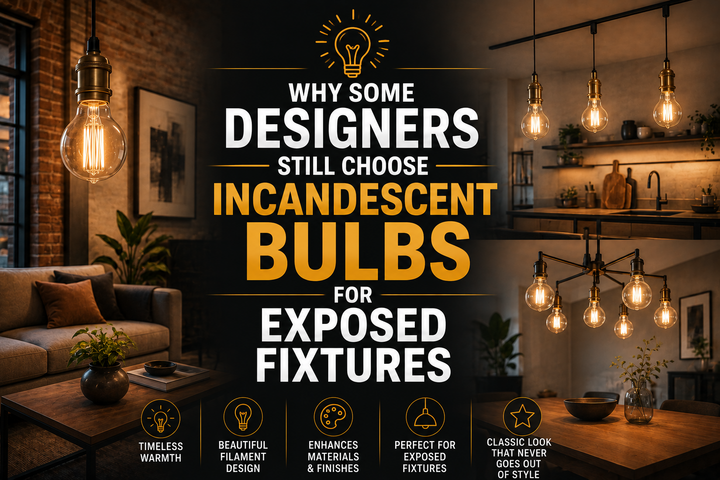
LED has become the default answer to almost every lighting question. Better efficiency, longer life, lower running costs on paper, it's hard to argue with any of that. But walk into a well-designed restaurant, boutique hotel lobby, or a stylish living room with an exposed pendant fixture, and you'll sometimes spot something surprising: a plain, old-school incandescent bulb, glowing away in full view, doing exactly the job it was meant to do.
That's not an oversight. In certain fixtures, it's a deliberate choice.
The Fixture Changes the Calculation
Most lighting decisions come down to one thing: is the bulb hidden or exposed? Behind a shade, inside a recessed can, tucked into a ceiling fixture nobody sees the bulb itself, only the light it casts. In those cases, efficiency and lifespan dominate the decision, and LED wins almost every time.
But open fixtures are a different story. Bare-bulb pendants, exposed filament fixtures, decorative sconces with visible tube-style bulbs in these setups, the bulb is part of the visual design. Its shape, its glow, the warmth of its color all become elements the designer is actively choosing, not just a means to an end.
This is where a classic incandescent tube bulb still holds its ground.
What an Exposed Bulb Actually Needs to Get Right
When a bulb is meant to be seen, a few things matter that don't get much attention in hidden fixtures:
-
Shape and proportion. A slim tubular profile reads very differently than a bulky, rounded bulb and in a minimalist or industrial-style fixture, that silhouette matters as much as the light output.
-
Glass clarity. Clear glass lets the filament (or the light source itself) become part of the aesthetic, rather than diffusing it into a flat glow.
-
Warmth of color. A 2700K color temperature gives off that classic, golden-amber warmth people associate with candlelight and old Edison bulbs a look that cooler LED tones often struggle to replicate convincingly.
-
Color accuracy. In spaces where the lighting needs to flatter skin tones, food, or fabric dining rooms, boutique retail, hospitality lobbies and a solid CRI rating keeps colors looking natural rather than flat.
Where This Actually Shows Up
Think about the kind of spaces that lean on this look:
Pendant lighting over a kitchen island or dining table. A cluster of bare bulbs hanging at different heights has become a signature look in modern farmhouse and industrial-style kitchens and it only works if the bulb itself looks good unshaded.
Boutique hospitality lighting. Small hotels, cafés, and wine bars often use exposed tube or vintage-style bulbs specifically because the warm, slightly nostalgic glow sets a mood that cooler, more clinical lighting can't replicate.
Accent and table lamps with open or minimal shades. When a lamp shade is more decorative than functional, the bulb's shape and warmth carry more of the visual weight than people usually realize.
Retail and display lighting. Some boutique retailers deliberately use exposed warm-toned bulbs to make merchandise feel more inviting, rather than sterile.
The Trade-Off Designers Accept
There's no getting around it: incandescent bulbs use more energy and have a shorter lifespan than their LED counterparts. That's a real trade-off, and it's worth being honest about it rather than pretending otherwise.
But in fixtures where the bulb is rarely on for hours at a stretch, accent lighting, occasional-use pendants, decorative table lamps the efficiency gap matters a lot less than it does for, say, a hallway light running all evening. For those applications, designers are often making a conscious trade: slightly higher running costs in exchange for a warmth and character that's genuinely hard to replicate.
A good example of a bulb built specifically for this kind of use is the T10 5" clear incandescent bulb 25W a slim tubular shape with clear glass and a warm 2700K glow, sized to work well in exposed pendant fixtures, table lamps, and other spots where the bulb itself is meant to be part of the look.
The Takeaway
Not every lighting decision comes down to efficiency alone. When a bulb is the visual centerpiece of a fixture rather than something hidden behind a shade its shape, clarity, and warmth become design choices in their own right. For those situations, a classic clear incandescent tube bulb still earns its place, not out of nostalgia, but because it does something specific that other technologies still haven't quite matched.
 Venues