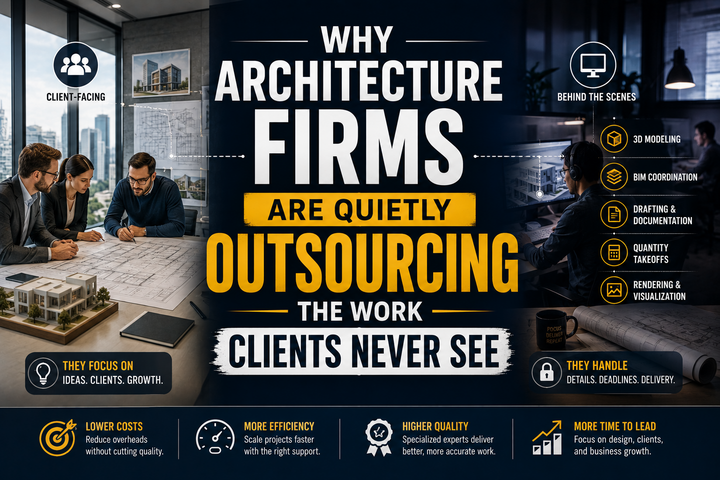
Walk through the workflow of a busy architecture firm and you'll find a pattern that's become increasingly common but rarely discussed openly: the conceptual design work, the creative decisions that define a project's character, happens entirely in-house, while a substantial amount of the detailed technical drafting, construction documentation, permit sets, gets produced by drafting teams the client never interacts with directly. This isn't a firm cutting corners. It's a deliberate specialization that's reshaping how architectural practices actually operate, and understanding why reveals something real about where design value actually gets created.
The two very different skill sets hiding inside "architecture"
Conceptual design and technical drafting require genuinely different skills, even though both fall under the broad umbrella of architectural work. Conceptual design is about spatial reasoning, aesthetic judgment, understanding client needs, and translating an abstract vision into a coherent architectural concept. Technical drafting is about precision, code compliance, construction methodology, and translating that concept into documents detailed enough for a contractor to actually build from without ambiguity.
A talented conceptual designer isn't automatically a fast, precise technical drafter, and a skilled technical drafter isn't automatically someone with strong creative design instincts. Firms that require every architect to be excellent at both are often getting mediocre outcomes on one side or the other, or paying premium salaries for a combination of skills that doesn't need to live in one person.
Why this specialization makes economic sense
Technical drafting, once a design concept is established, is genuinely a production process. It requires attention to detail, software proficiency, and knowledge of code requirements, but it doesn't require the same creative judgment as initial design development. This makes it well suited to specialized drafting teams who can produce detailed, accurate technical documentation efficiently, at a cost structure that doesn't require paying senior architectural salaries for production work.
A firm's senior designers, the people whose time is genuinely most valuable for creative problem solving and client relationships, get to spend their time on exactly that, rather than being pulled into hours of detailed CAD work producing construction documentation sets. The drafting work still needs to happen with precision and code compliance, it just doesn't need to happen at the hourly rate of a principal architect.
What actually gets outsourced and what stays in-house
The typical division, in firms that have specialized effectively, looks something like this: conceptual design, client relationships, creative problem solving, and design development stay firmly in-house, since these require deep understanding of the specific client and project context that's hard to hand off. Detailed technical drafting, construction documentation sets, permit drawings, and PDF-to-CAD conversion of existing hand sketches or older drawings often get produced by specialized drafting teams, whether that's an in-house drafting department or an outsourced partner.
This division isn't about cutting corners on quality, it's about matching the right skill set and cost structure to each part of the process. A permit drawing needs to be accurate and code-compliant. It doesn't need to be produced by the same person who conceived the building's overall design language.
Where this becomes particularly valuable
High-volume residential and commercial projects. Firms handling multiple simultaneous projects benefit enormously from having reliable drafting capacity that can scale without requiring every drafter to also be a strong conceptual designer.
PDF to CAD conversion work. Converting hand-drawn sketches or older paper drawings into precise digital CAD files is genuinely specialized, detail-oriented work that benefits from dedicated expertise rather than being handled ad hoc by whoever has spare time.
Construction documentation sets. The detailed as-built drawings, shop drawings, and interior elevations that make up a full documentation package require careful, methodical work that specialized drafting teams are often faster and more consistent at producing than generalist architectural staff juggling multiple responsibilities.
Permit drawings requiring specific regulatory knowledge. Navigating governmental regulations for quick approvals is its own specialized skill, one that benefits from drafters who work with these requirements regularly rather than occasionally.
Why clients don't need to worry about this division
For clients, understanding this specialization is genuinely reassuring rather than concerning, once you understand how it actually works. The creative vision and client relationship remain with the firm they hired. The technical execution, precision drafting, and code compliance work benefits from being handled by people whose entire job is getting those details exactly right. This division often produces better outcomes than forcing every step through the same generalist team, since each phase gets handled by people genuinely specialized in that specific work.
What to look for in a drafting partnership
Whether a firm builds an internal drafting team or partners with an external one, the key factors that determine quality are consistent: proficiency across the relevant software platforms, from AutoCAD for precise 2D documentation to Revit for BIM coordination, genuine understanding of code compliance requirements across residential, commercial, and industrial project types, and a workflow that maintains clear communication so the technical drawings accurately reflect design intent rather than requiring extensive revision cycles.
There's a comprehensive overview of what full-service architectural drafting services actually cover, from interior drafting drawings and construction documentation sets through PDF to CAD conversion and permit drawings, which is a useful context for understanding the full scope of technical work that goes into taking a design from concept to buildable documentation.
The bigger shift this reflects
The trend toward specialized drafting, whether in-house departments or outsourced partnerships, reflects something broader happening across creative and technical professions: recognizing that excellence at every stage of a process doesn't require the same person or team handling every stage. Architecture firms that have embraced this specialization are often able to take on more projects, produce more consistent technical documentation, and free their most experienced designers to focus on the work that most directly determines a project's ultimate quality and character.
For anyone hiring an architecture firm, understanding this division isn't a red flag, it's a sign of a mature, efficiently organized practice that's thinking carefully about where different kinds of expertise actually add the most value.
 Venues