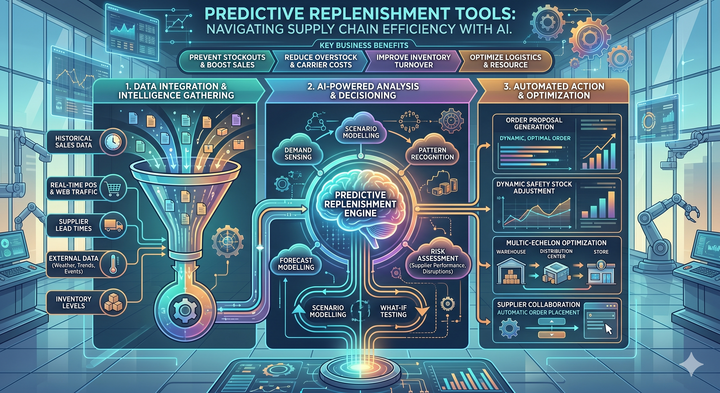
Inventory management has traditionally relied on a combination of historical sales analysis, manual planning, and predefined replenishment rules. While these approaches have helped retailers and supply chain teams maintain product availability for decades, they are becoming increasingly difficult to sustain in today's dynamic business environment. Customer demand changes rapidly, product assortments expand continuously, supply chain disruptions occur more frequently, and omnichannel fulfillment adds new layers of complexity to inventory decisions.
As a result, organizations are moving beyond traditional replenishment methods and embracing predictive replenishment tools powered by artificial intelligence (AI), machine learning, and advanced analytics. These technologies are enabling a significant shift toward self-optimizing inventory management, where systems continuously analyze data, adapt to changing conditions, and recommend or automate inventory decisions with minimal manual intervention.
Self-optimizing inventory management represents the next stage in inventory evolution. Instead of relying on static rules and reactive decision-making, organizations can leverage intelligent systems that learn from demand patterns, identify inventory risks, optimize replenishment strategies, and improve performance over time.
As retailers seek greater agility, efficiency, and profitability, predictive replenishment tools are becoming a critical foundation for building self-optimizing inventory operations.
Understanding Traditional Inventory Management
Historically, inventory management focused on maintaining sufficient stock levels to meet customer demand while controlling inventory costs.
Common approaches included:
- Historical sales forecasting
- Fixed reorder points
- Manual replenishment planning
- Safety stock calculations
- Spreadsheet-based inventory analysis
While these methods remain useful in certain scenarios, they often struggle in rapidly changing environments.
Modern retail requires faster, more adaptive decision-making.
Why Inventory Management Is Becoming More Complex
Several factors are increasing inventory complexity.
Demand Volatility
Customer preferences change more quickly than ever before.
Omnichannel Fulfillment
Retailers must support inventory availability across multiple channels.
Expanding Product Assortments
Larger catalogs create additional planning challenges.
Supply Chain Disruptions
Lead times and supplier performance can fluctuate unexpectedly.
Rising Customer Expectations
Consumers expect products to be available whenever and wherever they choose to shop.
These challenges require more intelligent inventory management capabilities.
What Are Predictive Replenishment Tools?
Predictive replenishment tools are advanced inventory planning solutions that use:
- Artificial intelligence
- Machine learning
- Predictive analytics
- Real-time demand signals
to forecast future inventory requirements and optimize replenishment decisions.
Unlike traditional systems that rely primarily on historical data, predictive replenishment platforms continuously evaluate changing conditions and adapt recommendations accordingly.
This enables more proactive inventory management.
What Is Self-Optimizing Inventory Management?
Self-optimizing inventory management refers to the use of intelligent systems that automatically analyze inventory conditions, predict future requirements, and continuously improve replenishment decisions.
Rather than relying heavily on manual oversight, self-optimizing systems can:
- Detect demand changes
- Adjust forecasts
- Optimize inventory levels
- Recommend replenishment actions
- Learn from outcomes
The objective is to improve inventory performance while reducing operational complexity.
Why Retailers Are Moving Toward Self-Optimization
Traditional inventory management often requires significant manual effort.
Planners must:
- Analyze forecasts
- Monitor inventory levels
- Review replenishment schedules
- Respond to exceptions
As assortments and supply chains grow more complex, manual processes become increasingly difficult to scale.
Self-optimizing systems help organizations manage complexity more effectively.
How Predictive Replenishment Tools Enable Self-Optimizing Inventory Management
Continuous Demand Forecasting
Forecasting is the foundation of inventory management.
Predictive replenishment tools continuously analyze:
- Historical sales
- Customer demand signals
- Seasonal trends
- Promotional activity
- Market conditions
Machine learning models update forecasts automatically as new information becomes available.
This improves forecasting accuracy over time.
Leveraging Real-Time Demand Signals
Customer demand can shift rapidly.
Predictive replenishment systems incorporate real-time signals such as:
- Point-of-sale transactions
- Ecommerce purchases
- Product searches
- Website traffic
- Cart activity
These signals help identify emerging trends earlier than traditional forecasting methods.
This enables faster inventory adjustments.
Dynamic Inventory Optimization
Traditional inventory policies often rely on static rules.
Self-optimizing systems continuously evaluate:
- Demand variability
- Inventory positions
- Lead times
- Service level objectives
and adjust inventory recommendations automatically.
This improves inventory efficiency while maintaining product availability.
Automated Replenishment Decisions
Predictive replenishment tools increasingly automate routine decisions.
Systems can recommend:
- Order quantities
- Replenishment timing
- Inventory transfers
- Supplier allocations
Automation reduces manual workload and improves decision consistency.
Dynamic Safety Stock Management
Safety stock protects against uncertainty.
However, static safety stock policies often result in excess inventory or insufficient protection.
Self-optimizing systems adjust safety stock dynamically based on:
- Demand volatility
- Lead time reliability
- Service targets
This balances availability and inventory costs more effectively.
Learning from Inventory Outcomes
One of the defining characteristics of self-optimizing systems is their ability to learn.
Machine learning algorithms evaluate:
- Forecast performance
- Replenishment outcomes
- Inventory utilization
- Demand patterns
This continuous learning process improves future recommendations.
The system becomes more effective over time.
Managing Omnichannel Inventory More Effectively
Retailers often manage inventory across:
- Physical stores
- Distribution centers
- Ecommerce fulfillment centers
- Marketplace operations
Self-optimizing replenishment systems help determine:
- Where inventory should be positioned
- Which locations require replenishment
- How inventory should be allocated
This improves inventory productivity across channels.
Responding Faster to Market Changes
Retail environments change constantly.
Examples include:
- Seasonal demand shifts
- Viral product trends
- Competitive promotions
- Economic fluctuations
Predictive replenishment tools help organizations identify these changes earlier and respond more quickly.
This improves agility.
Reducing Inventory Risks
Inventory risks often include:
- Stockouts
- Excess inventory
- Obsolescence
- Misallocated inventory
Self-optimizing systems continuously monitor inventory conditions and identify potential risks before they become costly problems.
This enables proactive intervention.
Improving Supplier Collaboration
Supplier performance directly influences replenishment outcomes.
Predictive replenishment systems improve collaboration by sharing:
- Demand forecasts
- Inventory requirements
- Replenishment plans
- Supply constraints
This helps suppliers align production and delivery schedules with retailer needs.
AI as the Engine Behind Self-Optimization
Artificial intelligence powers many of the capabilities associated with self-optimizing inventory management.
AI helps organizations:
- Identify demand patterns
- Predict future requirements
- Optimize inventory allocation
- Recommend actions automatically
Without AI, managing this level of complexity would be difficult at scale.
Benefits of Self-Optimizing Inventory Management
Improved Forecast Accuracy
Continuous learning enhances prediction quality.
Higher Product Availability
Inventory aligns more closely with demand.
Reduced Excess Inventory
Organizations avoid unnecessary stock accumulation.
Better Working Capital Efficiency
Inventory investments become more productive.
Faster Decision-Making
Automation accelerates inventory responses.
Increased Supply Chain Agility
Organizations adapt more quickly to change.
Common Challenges Organizations Face
Data Quality Issues
AI performance depends on accurate data.
System Integration Complexity
Inventory systems often span multiple platforms.
Organizational Change Management
Teams must adapt to automated decision-making processes.
Demand Volatility
Rapid market shifts require ongoing optimization.
Addressing these challenges is critical for success.
Best Practices for Self-Optimizing Inventory Management
Invest in High-Quality Data
Reliable data improves AI performance.
Leverage Real-Time Demand Signals
Current customer behavior enhances responsiveness.
Integrate Inventory Systems
Unified data supports better optimization.
Continuously Monitor AI Performance
Models should evolve alongside business conditions.
Balance Automation and Human Oversight
Strategic oversight remains important for exceptional situations.
Key Metrics to Track
Organizations should monitor:
- Forecast accuracy
- Inventory turnover
- Stockout rates
- Fill rates
- Days of inventory on hand
- Inventory carrying costs
- Working capital utilization
These metrics help evaluate inventory optimization effectiveness.
 Venues